
Eastern Turkic Khaganate
Eastern successor of the splintered First Turkic Khaganate.

Türk-Genci8 · CC BY-SA 4.0
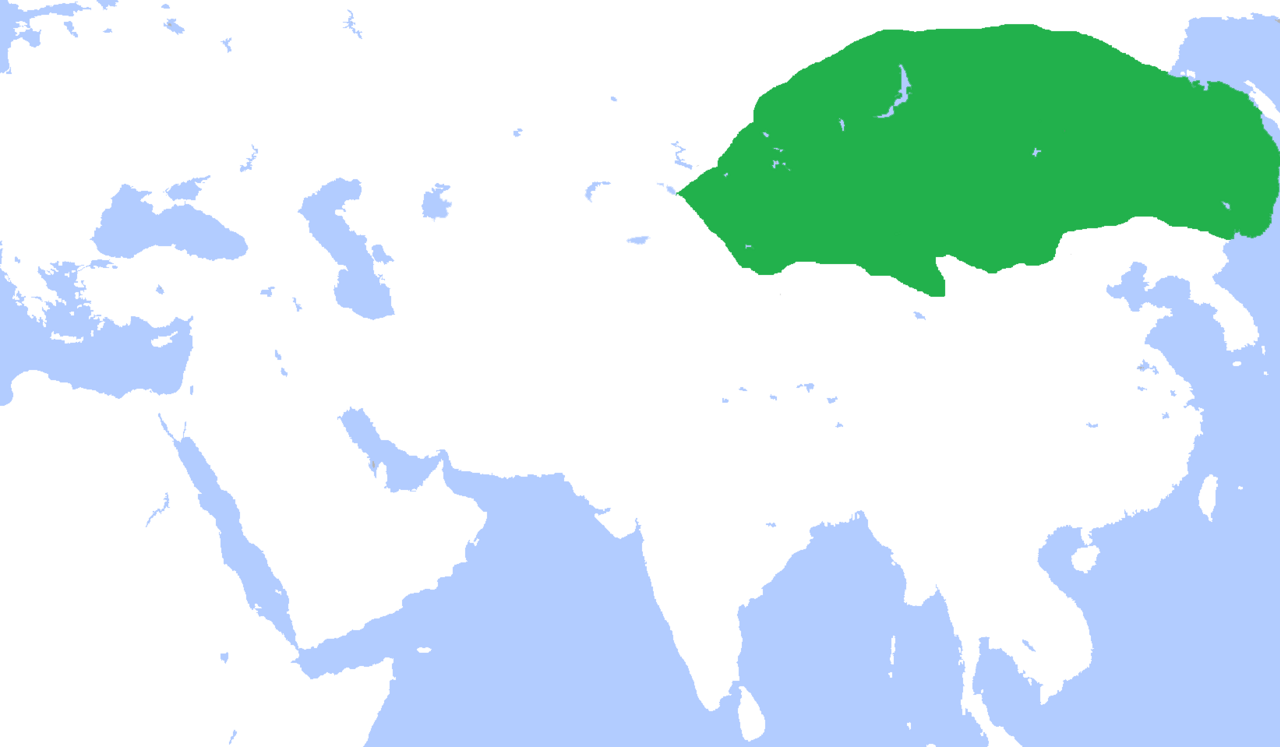
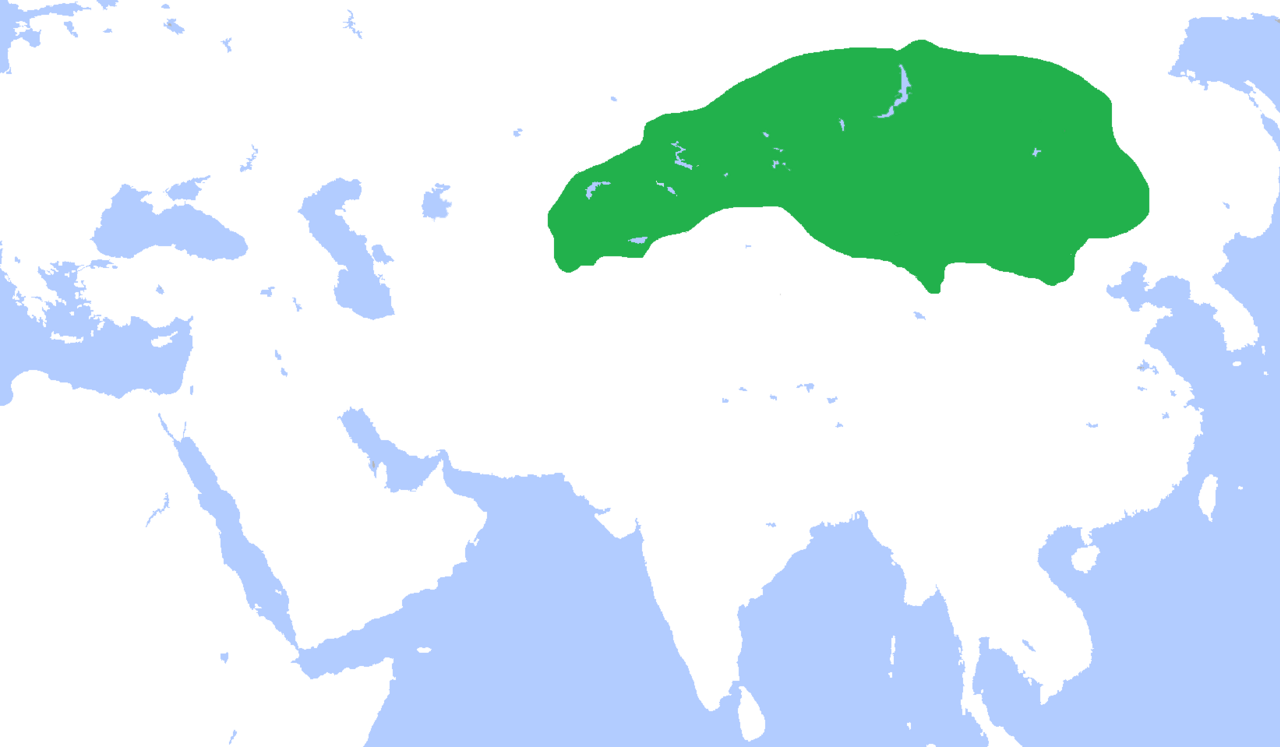
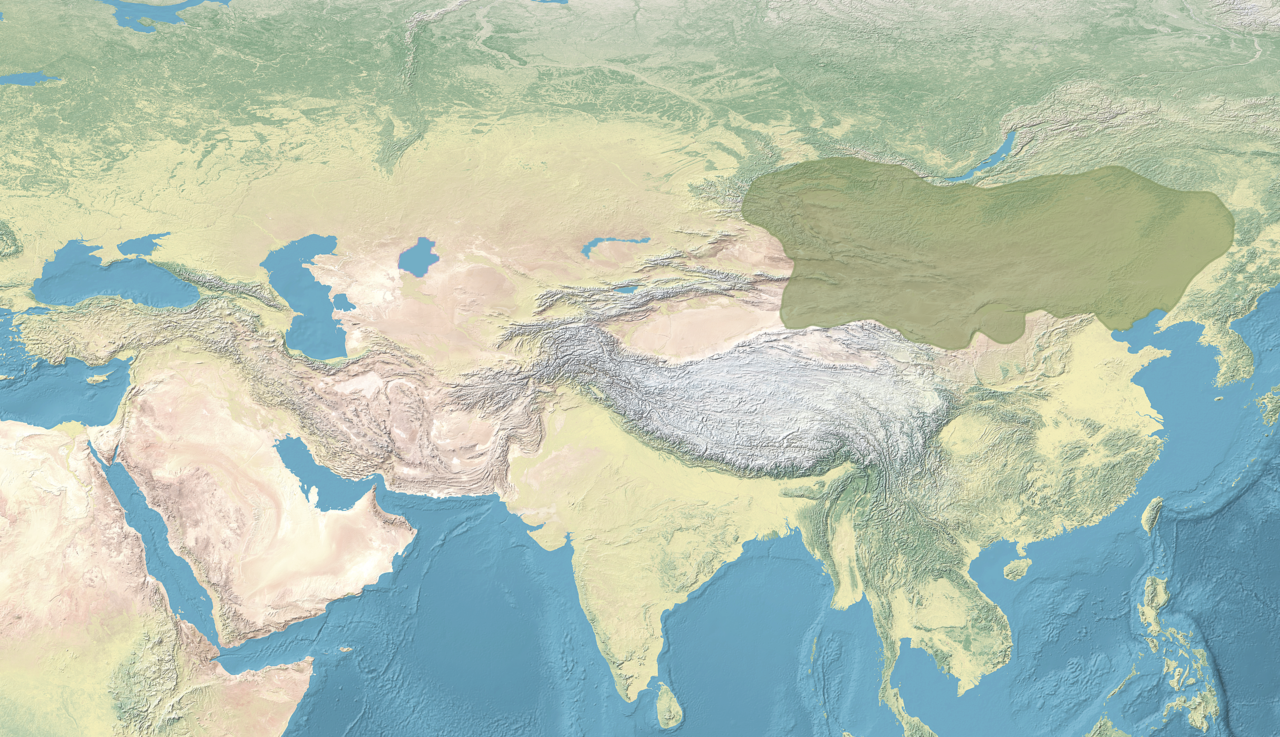
The Eastern Turkic Khaganate was formed as a result of destructive wars in the beginning of the 7th century (AD 581–603) after the First Turkic Khaganate, founded in the 6th century on the Mongolian Plateau by the Ashina clan, splintered into two polities – one in the east, one in the west. It was defeated and absorbed by the Tang dynasty, and Xueyantuo occupied the territory of the former Turkic Khaganate.
- formed
- AD 581–603
- defeated
- 630
- location
- Mongolian Plateau
- preceded_by
- First Turkic Khaganate
- succeeded_by
- Tang dynasty absorption; Xueyantuo occupation
- ruling_clan
- Ashina
- known_for
- Conflict with Sui and Tang dynasties; east-west split of Turkic empire
Lore & Background
The Eastern Turkic Khaganate emerged from the civil wars that split the First Turkic Khaganate between 581 and 603. The eastern branch was initially a vassal of the Sui dynasty under Yami Qaghan (603–609), who admired Han culture and had the Han people build him a house in the Ordos country. As Sui power waned, later khagans such as Shibi Qaghan (609–619) asserted independence. In 615, the Sui lured his Sogdian advisor into a trap and killed him; Shibi stopped paying tribute and briefly besieged Emperor Yang of Sui in Shanxi. In 617, Li Yuan, who would become the first Tang emperor, faced tens of thousands of Turks at Taiyuan but deceived them into retreating by leaving the gates open and the city quiet. Shibi's younger brother Chuluo (619–620) ruled for only 18 months. The next brother, Illig Qaghan (620–630), was the last independent ruler. He led yearly raids against the new Tang dynasty. In 626, he reached the gates of Chang'an. Emperor Taizong of Tang, who had just overthrown his father, chose to pay an enormous ransom. In 627–629, an unusual cold led to mass livestock deaths and famine. Instead of lowering taxes, Illig raised them. The Xueyantuo, Uyghurs, Bayegu and some of Illig's people rebelled and in 629 were joined by the Khitans and Taizong. Six Tang armies attacked on a 1,200 km front in the Tang campaign against the Eastern Turks. Illig was captured in 630.
Reader's Guide
The Eastern Turkic Khaganate represents a critical phase in the history of the Turkic peoples and their interactions with China. Its formation from the splintering of the First Turkic Khaganate illustrates the fragility of steppe empires, often divided by succession disputes and external manipulation. The Khaganate's ability to extract tribute from weak Central Plain regimes and later challenge the Tang dynasty shows the military and political power of the nomadic confederation. However, its downfall was hastened by environmental disaster, internal rebellion, and the strategic patience of Emperor Taizong, who built up his cavalry and exploited divisions. After the fall of the Khaganate, Zhenzhu Khan (629–645) of the Xueyantuo ruled much of the north. Taizong made the Ashina live inside the Ordos Loop. In 639, after Ashina Jiesheshuai attempted to assassinate Emperor Taizong, Taizong made them live between the Yellow River and Gobi under Qilibi Khan (639–643) as a buffer state between China and the Xueyantuo. In 642 the Xueyantuo drove them south of the river. Zhenzhu's son Duomi Khan (645–646) planned to attack China. Taizong allied with the Uyghurs and broke up the Xueyantuo clan. The Ashina Chebi Khan (646–650) tried to revive the Khaganate but was captured by the Chinese and Uyghurs. Two more attempts by Ashina Nishufu (679–680) and Ashina Funian (680–681) failed. Turkic power was restored by the Second Turkic Khaganate (682–744).
Did You Know?
- The ethnonym 'Türk' is ultimately derived from the Old-Turkic migration-term Türük/Törük, meaning 'created, born'.
- In 552, Bumin Qaghan was denounced as a 'blacksmith slave' by the Rouran when he demanded a royal bride.
- In 626, Illig Qaghan reached the gates of Chang'an, and Emperor Taizong paid an enormous ransom.
- An unusual cold from 627 to 629 caused mass livestock deaths and famine, contributing to the Khaganate's fall.
- The Chinese Book of Zhou presents a folk etymology of the name Turk as derived from 'helmet', based on a mountain shape in the Altai.
Origins: The Ashina and the Birth of the Türk Name
The ethnonym Türk traces to an Old Turkic migration term meaning 'created, born' or 'strong,' rooted in a word connected to tribal ancestry and the prime of life. A competing folk etymology, preserved in the seventh-century Chinese Book of Zhou, linked the name to 'helmet,' supposedly from the shape of a mountain in the Altai where the people worked in metal. In 439, a man surnamed Ashina led five hundred families west from Gansu toward Gaochang near Turfan. Around 460, the Rouran pushed them east to the Altai, a region vital for metalwork supplying Siberia and Mongolia. The first dated Chinese mention of 'Turk' appears in 542, when they conducted annual raids across the frozen Yellow River. By 545, the future Bumin Qaghan was already negotiating directly with the Western Wei, bypassing his Rouran overlords. When the Rouran sent the Turks east to suppress a Kao-ch'e rebellion, the Turks absorbed the defeated group into their own ranks. Bumin's demand for a royal Rouran bride was rejected; he was denounced as a 'blacksmith slave.' He instead took a bride from the Western Wei, defeated the Rouran ruler in Jehol, and assumed the title of Khagan in 552.
The East-West Schism and Sui Interference
Between 581 and 603, the unified Göktürk empire fractured into eastern and western polities, a division that would define Central Asian politics for decades. The western half passed to Bumin's younger brother Istämi and later his son Tardu, while the eastern half on the Mongolian Plateau endured a brutal succession crisis. When Taspar Qaghan died in 581, the same year the Sui dynasty was founded, three rival claimants emerged. The elders rejected Taspar's chosen successor Apa Qaghan in favor of Anluo, who quickly yielded to Ishbara Qaghan. In 587, both Apa and Ishbara died amid the civil war. Tulan Qaghan, Ishbara's son, eventually ruled the east but stopped paying tribute to the Sui in 587 and was assassinated two years later. Tardu moved from the west and briefly reunified the Turkic world from 599 to 603, but Sui interference—poisoning wells to force his retreat—ensured the split became permanent.
Imperial Reach and Silk Road Economics
Under Bumin and his successors, the Göktürk empire rapidly expanded westward, reaching the Caspian Sea and the Oxus River. Istämi, who governed the western half, pushed the frontier to these distant waterways, while Muqan Qaghan in the east finished off the surviving Rouran, pushed the Kitans further east, and brought the Yenisei Kyrgyz under Turkic control. The empire's capture of the Tarim Basin proved economically transformative: it placed the Silk Road trade routes and the Sogdian merchant networks that managed them directly under Göktürk authority. The Eastern Turks extracted enormous tribute from the Chinese dynasties of the Central Plain, including the Western Wei and Northern Zhou, demanding as much as one hundred thousand rolls of silk annually. They attempted to resell this silk in Central Asia, turning the tribute system into a commercial engine. In the early period, the Chinese regimes were weak enough to pay tribute to the Göktürks at times, a reversal of the traditional tributary relationship that would later be dramatically corrected by the Tang.
The Tang Conquest and the Aftermath
The Eastern Turkic Khaganate's independence lasted from 603 until 630, when the Tang dynasty overthrew it and absorbed its territory. The Sui dynasty, founded in 581, had already begun pushing back against Turkic power by supporting or bribing rival factions against one another, a strategy that kept the eastern khaganate perpetually unstable. The Sui even resorted to poisoning wells to force Tardu's retreat during his brief reunification attempt. After the Sui's fall, the Tang inherited and intensified this pressure. The final collapse of the Eastern Turkic Khaganate in 630 marked the end of the First Turkic Khaganate (552–630), a polity that had dominated the Mongolian Plateau for nearly a century. In the power vacuum that followed, Xueyantuo occupied the territory of the former Turkic Khaganate, demonstrating that the region's political landscape remained fluid even after the Göktürk structure dissolved. The Tang's victory also reversed the tributary relationship that had seen Chinese dynasties paying silk to Turkic overlords, reasserting Chinese primacy over the steppe for a generation.
Gallery



Frequently Asked Questions
What is the Eastern Turkic Khaganate?
It was the eastern half of the original Turkic empire that broke apart after the devastating internal wars of 581–603. Ruled by the Ashina clan, it controlled the Mongolian Plateau and stood as one of East Asia's dominant powers in the early 7th century.
How did the Eastern Turkic Khaganate come into being?
The First Turkic Khaganate fractured into two rival halves following a period of devastating civil conflict between AD 581 and 603. The eastern fragment reorganized itself into a new khaganate that carried the Turkic political legacy forward.
What territory did the Eastern Turkic Khaganate control?
Its core domain was the Mongolian Plateau, making it the dominant steppe power in that region during the early 600s. It existed as a successor state to the broader First Turkic Khaganate that had previously held sway across the central Asian grasslands.
How does the Eastern Turkic Khaganate's story end?
In 630, Tang dynasty forces decisively defeated the khaganate and absorbed its territory into the Chinese imperial sphere. The Ashina ruling line was effectively dissolved as an independent political force after this conquest.
Why is the Eastern Turkic Khaganate important in medieval Asian history?
It represents a critical link in the chain of Turkic steppe empires and a direct challenger to Chinese dynastic authority during the Tang period. Its rise and fall shaped the balance of power between the steppe and the sedentary civilizations of East Asia for generations.
More in Medieval And Early Modern Asian Empires 1-23
Related in Medieval And Early Modern Asian Empires
Links follow this subject's own source article.
Spotted an error? Know more?
This is a living reference — every entry is fact-audited, and reader corrections feed straight into our audit queue. Suggest an edit · See this site's audit record